
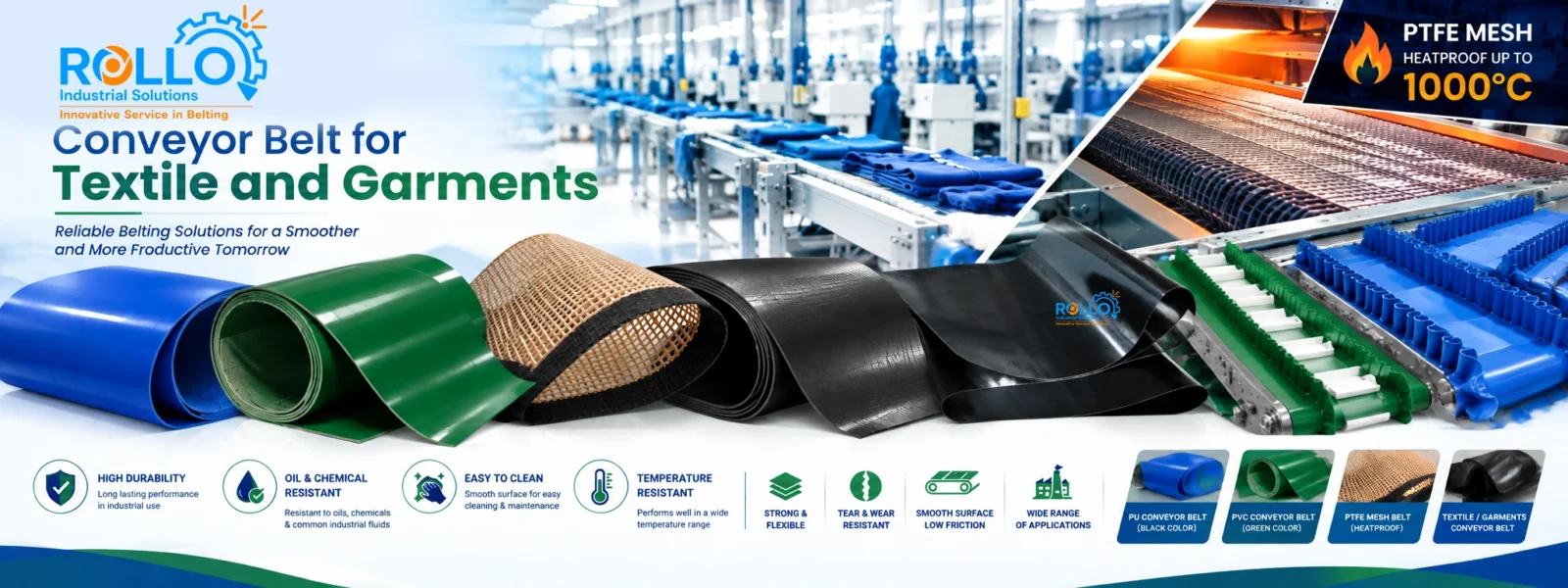
Heat-Resistant Conveyor Belt in Bangladesh ROLLO
Heat Resistance Conveyor Belt in Bangladesh is an important industrial solution for factories where products, materials, or processes involve elevated temperatures. In Bangladesh, industries such as food processing, biscuit manufacturing, bakery, textile, garments, printing, packaging, coating, drying, heat-setting and other manufacturing sectors require conveyor belts that can operate reliably under demanding temperature conditions.
ROLLO INDUSTRIAL SOLUTIONS supplies different types of industrial conveyor belts for heat-related applications, including PU Heat Resistant Conveyor Belt, PTFE Conveyor Belt, PTFE Teflon Conveyor Belt, PTFE Mesh Conveyor Belt and Teflon Mesh Belt. The correct belt depends on the machine design, operating temperature, product temperature, belt speed, belt width, pulley diameter, working environment and required joining method.
Not every conveyor belt is suitable for high-temperature applications. A belt that works perfectly at normal room temperature may lose its properties when continuously exposed to heat. Therefore, choosing the correct belt material and construction is an important part of conveyor system design.
Heat Resistant Conveyor Belt Supplier in Bangladesh
ROLLO INDUSTRIAL SOLUTIONS is a Bangladesh-based industrial conveyor belt supplier serving different manufacturing and processing requirements. We focus on conveyor belts and related belt solutions for industrial machinery.
Our product selection includes:
- PU Heat Resistant Conveyor Belt
- PU Conveyor Belt for Biscuit Cooling Applications
- PTFE Conveyor Belt
- PTFE Teflon Conveyor Belt
- PTFE Mesh Conveyor Belt
- PTFE Teflon Mesh Belt
- PTFE Open Mesh Conveyor Belt
- PTFE Coated Conveyor Belt
- PVC Conveyor Belt
- PU Food Grade Conveyor Belt
- Rubber Conveyor Belt
- Specialized Industrial Conveyor Belts
Our products are imported high-quality industrial belts selected according to application requirements. Before supplying a belt, it is important to understand the customer’s machine and operating conditions rather than selecting a belt based only on width or thickness.
What Is a Heat Resistant Conveyor Belt?
A heat resistant conveyor belt is a conveyor belt designed for applications where the belt or the material being transported is exposed to elevated temperatures. The exact temperature capability depends on the belt’s construction and material.
Heat resistance is not determined only by the belt’s appearance. Important factors include:
- Belt material
- Surface coating
- Fabric or carcass construction
- Belt thickness
- Operating temperature
- Peak temperature
- Continuous exposure time
- Belt speed
- Product temperature
- Heating method
- Cooling or airflow conditions
- Pulley diameter
- Mechanical tension
- Chemical exposure
For this reason, a professional belt supplier should review the complete application before recommending a specific heat-resistant conveyor belt.
Types of Heat Resistant Conveyor Belt Available from ROLLO
Heat-related conveyor applications are not all the same. A biscuit cooling conveyor, a textile heat-setting machine, and a high-temperature drying machine can require completely different belt constructions.
At ROLLO, heat-related conveyor belt requirements can generally be divided into two major groups:
- PU-based heat-resistant conveyor belt solutions
- PTFE / Teflon and PTFE Mesh conveyor belt solutions
Each type has different characteristics and should be selected according to the application.
PU Heat Resistant Conveyor Belt in Bangladesh
PU Heat Resistant Conveyor Belt can be used for selected applications where a polyurethane conveyor belt is required, and the operating temperature is within the specification of the particular belt.
PU conveyor belts are widely used in food processing, bakery, biscuit, packaging, and material handling systems. However, it is important to distinguish a standard PU conveyor belt from a specially designed heat-resistant PU belt. Standard PU belts should not automatically be treated as high-temperature belts.
For warm-product handling, biscuit cooling, bakery production and similar applications, the correct PU construction should be selected based on the actual temperature and machine conditions.
PU Conveyor Belt for Biscuit Cooling
The biscuit industry is one of the important applications where conveyor belts are used for product transfer and cooling.
After baking, biscuits can remain warm and need to pass through a cooling conveyor before further processing, inspection, stacking or packaging. The conveyor belt therefore needs to maintain its mechanical properties while carrying warm products and operating continuously.
Depending on the production line, the conveyor can be straight, inclined, multi-level or curved. The belt selection should take into consideration the product temperature and the actual operating environment.
For biscuit cooling conveyors, important selection points include:
- Biscuit temperature when it contacts the belt
- Required belt width
- Conveyor length
- Belt speed
- Pulley diameter
- Conveyor configuration
- Product weight
- Required surface grip
- Cleaning requirements
- Food-contact requirements where applicable
- Joining method
Curved PU Conveyor Belt for Biscuit Cooling
Some production lines require a curved conveyor to save factory floor space. Instead of moving the product in a straight line, the conveyor changes direction through a curve.
A curved conveyor belt requires careful consideration of belt construction, tracking, pulley arrangement and belt tension. The belt should be selected according to the conveyor design rather than simply choosing a belt with the same width as a straight conveyor.
ROLLO can help customers identify the appropriate conveyor belt specification for curved and special conveyor applications based on machine dimensions and operating conditions.
PTFE Conveyor Belt in Bangladesh
PTFE Conveyor Belt is another important category for heat-resistant industrial applications. PTFE is known for properties such as high temperature capability, non-stick performance, chemical resistance and low-friction characteristics.
PTFE conveyor belts can be manufactured in different constructions depending on the application. One of the most widely recognized forms is the PTFE Mesh Conveyor Belt.
PTFE belts are particularly useful in applications where both heat resistance and a release/non-stick surface are important.
PTFE Teflon Conveyor Belt
The terms PTFE Conveyor Belt and PTFE Teflon Conveyor Belt are commonly used when searching for belts made using PTFE-coated materials. Teflon is a well-known trademark associated with PTFE materials, while PTFE is the technical material designation.
In industrial belt purchasing, customers should focus on the actual construction and specification rather than the name alone.
A PTFE belt can differ significantly from another PTFE belt in terms of:
- PTFE coating
- Base fabric
- Mesh opening
- Open area
- Thickness
- Surface finish
- Edge construction
- Mechanical strength
- Operating temperature
- Belt width
- Joining method
PTFE Mesh Conveyor Belt in Bangladesh
PTFE Mesh Conveyor Belt is one of the most important heat-resistant conveyor belt solutions for industrial drying and heating applications.
The open mesh construction allows air to move through the belt. This makes PTFE mesh belts suitable for machines where hot air needs to circulate around the product.
Depending on machine design, PTFE mesh belts can be used in applications involving:
- Hot-air drying
- Industrial drying
- Textile processing
- Garment finishing
- Heat setting
- Curing
- Coating
- Printing processes
- Fusing applications
- Oven systems
- Dryer machines
- Non-stick conveying
PTFE Teflon Mesh Conveyor Belt for Textile Industry
PTFE Teflon Mesh Conveyor Belt for Textile Industry is an important industrial application of PTFE mesh belts.
Textile and garment factories use different types of heating, drying, curing, coating and finishing machinery. In applications where the conveyor belt is exposed to elevated temperatures and hot air, a PTFE mesh belt may be suitable depending on the machine design.
The open mesh structure can allow hot air to circulate through the textile material. This can be useful in drying and heat-processing equipment where airflow is an important part of the process.
Potential textile applications include:
- Textile drying machines
- Fabric drying systems
- Heat-setting machines
- Textile coating lines
- Garment finishing equipment
- Fusing applications
- Thermal processing equipment
- Hot-air circulation systems
- Textile printing and curing applications
- Industrial fabric treatment equipment
The exact suitability of a PTFE mesh belt depends on the machine temperature, speed, belt construction and process requirements.
PTFE Mesh Belt for Textile Drying Machine
Textile drying machines require controlled heat and airflow. A conveyor belt used inside such equipment needs to withstand the operating environment while allowing the process air to reach the textile material.
PTFE mesh belts can be considered for these applications because the open mesh structure provides airflow through the belt.
When selecting a PTFE mesh belt for a textile dryer, buyers should provide:
- Machine name
- Machine working temperature
- Belt width
- Belt length
- Mesh opening
- Required open area
- Belt thickness
- Machine speed
- Pulley diameter
- Existing belt specification
- Joining arrangement
- Edge treatment requirement
PTFE Mesh Belt for Heat Setting Machine
PTFE Mesh Conveyor Belt for Heat Setting Machine is another important search requirement in the textile sector.
Heat-setting processes expose fabrics to controlled heat for specific processing requirements. The conveyor belt operating inside the machine must be compatible with the machine’s temperature, speed, tension and mechanical configuration.
PTFE mesh can be suitable for selected heat-setting systems because of its temperature capability, low-friction surface and open construction.
However, the correct mesh type should always be selected based on the actual machine specification. Mesh size and open area can influence airflow, product support and machine performance.
PTFE Mesh Conveyor Belt for Garment Industry
The garment industry uses various thermal processing machines. Depending on the process, PTFE mesh belts may be used in drying, curing, fusing, coating and other heat-related operations.
For garment and textile applications, belt selection should consider not only temperature resistance but also:
- Fabric type
- Fabric weight
- Required airflow
- Machine speed
- Heat exposure time
- Mesh opening
- Belt tension
- Tracking system
- Pulley size
- Joining system
A belt suitable for one textile machine may not be suitable for another machine even when both machines operate at similar temperatures.
Why PTFE Mesh Conveyor Belt Is Used in Heat Applications
PTFE mesh conveyor belts offer several properties that can be useful in industrial heating and drying environments.
1. High Temperature Capability
PTFE-based materials are widely selected for applications involving elevated temperatures. However, the actual maximum operating temperature must be confirmed from the specific belt construction and supplier specification.
2. Non-Stick Surface
PTFE is known for its non-stick characteristics. This can be useful where materials should release easily from the conveyor surface.
3. Open Mesh Construction
Open mesh allows air to pass through the belt. This characteristic is especially useful in drying and hot-air processing applications.
4. Chemical Resistance
PTFE has strong chemical resistance characteristics, which can be useful in selected industrial processing environments.
5. Low Friction
The surface properties of PTFE can provide low-friction characteristics, which may be beneficial in specific conveyor and processing systems.
6. Easy Product Release
Where sticky or coated materials are being processed, the non-stick nature of PTFE can help reduce product adhesion to the belt surface.
PTFE Solid Belt vs PTFE Mesh Belt
PTFE conveyor belts are not limited to mesh construction. Depending on the application, a solid or coated PTFE belt may be considered.
PTFE Mesh Belt: Suitable where airflow and heat circulation through the belt are important.
PTFE Solid/Coated Belt: Suitable for applications where a more continuous surface is required and airflow through the belt is not the primary requirement.
The choice should be based on the production process rather than simply selecting the belt with the highest temperature rating.
Heat Resistant Conveyor Belt Temperature
One of the most common questions from buyers is: How much temperature can a heat-resistant conveyor belt handle?
There is no single temperature rating that applies to every heat-resistant conveyor belt.
The temperature capability depends on:
- PU or PTFE material
- Belt construction
- Coating
- Fabric substrate
- Belt thickness
- Continuous operating temperature
- Short-duration peak temperature
- Direct contact with hot material
- Hot-air exposure
- Belt speed
- Exposure duration
Therefore, ROLLO recommends providing the actual operating temperature before ordering a heat-resistant belt.
For example, a belt carrying warm biscuits may experience a different thermal load compared with a PTFE mesh belt running continuously inside a textile dryer.
How to Select Heat Resistant Conveyor Belt in Bangladesh
Selecting the correct belt starts with collecting the correct technical information.
Belt Width
Provide the required belt width in millimeters. If replacing an existing belt, measuring the old belt can help establish the required size.
Belt Length
Provide the required endless belt length or the conveyor dimensions from which the belt length can be calculated.
Operating Temperature
This is one of the most important specifications. Tell the supplier both the normal operating temperature and the highest expected temperature.
Product Temperature
For biscuit, bakery and food-processing applications, provide the temperature of the product when it first contacts the belt.
Belt Speed
High-speed conveyor systems can create different mechanical conditions from slow conveyors. Belt speed should therefore be considered during selection.
Pulley Diameter
Minimum pulley diameter is important because a belt must be able to flex around the conveyor pulley without excessive stress. The required minimum pulley diameter depends on the belt construction and thickness.
Mesh Size for PTFE Belts
For PTFE mesh belts, mesh opening is an important specification. Different mesh sizes provide different airflow and product-support characteristics.
Belt Thickness
Belt thickness affects flexibility, mechanical properties, pulley requirements and overall machine performance.
Joining Method
The appropriate joining method depends on the belt construction. Thermoplastic PU belts may use suitable thermoplastic joining techniques such as finger joining where compatible with the belt construction.
PTFE mesh belts can require different joining arrangements depending on their construction and machine design, such as suitable mechanical or manufacturer-approved joining systems.
The joining method should always be selected according to the specific belt rather than applying one joining method to every heat-resistant belt.
Heat Resistant Conveyor Belt for Food Industry
Food processing applications require additional attention to hygiene, cleaning and food-contact requirements.
For biscuit, bakery and food production lines, buyers should identify whether the belt is required to be food-contact suitable and what cleaning chemicals or procedures are used.
Important factors include:
- Food-contact requirement
- Operating temperature
- Product temperature
- Cleaning method
- Water exposure
- Oil and fat exposure
- Belt surface
- Product release characteristics
- Belt speed
- Pulley diameter
For a food production line, belt selection should be based on the exact process and applicable food-contact requirements.
Heat Resistant Conveyor Belt for Textile Industry
The textile sector has different conveyor belt requirements compared with food processing.
Textile machinery may require belts that can operate inside drying, curing, heat-setting, coating or finishing equipment. PTFE and PTFE mesh belts can be suitable for selected applications where high-temperature performance and airflow are required.
For textile applications, ROLLO can help customers review:
- Machine temperature
- Belt width
- Belt length
- Mesh opening
- Open area
- Belt thickness
- Machine speed
- Pulley diameter
- Existing belt construction
- Joining requirement
Common Applications of Heat Resistant Conveyor Belt
- Biscuit cooling conveyor
- Bakery conveyor
- Food processing conveyor
- Industrial drying machine
- Textile drying machine
- Heat-setting machine
- Garment finishing machine
- Textile coating machine
- Curing equipment
- Hot-air dryer
- Oven conveyor
- Fusing equipment
- Industrial heating line
- Non-stick material handling
Heat Resistant Conveyor Belt Price in Bangladesh
The Heat Resistant Conveyor Belt Price in Bangladesh depends on several technical factors. It is difficult to provide one fixed price because different belts can have significantly different constructions.
Price can depend on:
- Belt material
- PU or PTFE construction
- Belt thickness
- Belt width
- Total length
- Mesh specification
- PTFE coating
- Fabric construction
- Joining requirement
- Edge treatment
- Special manufacturing requirements
For an accurate quotation, customers should provide the belt width, length, thickness, temperature, application and machine details.
PTFE Teflon Mesh Belt Price in Bangladesh
The price of a PTFE Teflon Mesh Belt in Bangladesh depends strongly on the mesh construction and specification.
Two belts may both be called PTFE mesh belts but have different mesh openings, fabric constructions, thicknesses and mechanical characteristics. Therefore, price comparison should always be made between equivalent specifications.
When requesting a quotation, provide a machine photograph or the existing belt sample/specification whenever possible.
Why Choose ROLLO INDUSTRIAL SOLUTIONS?
ROLLO INDUSTRIAL SOLUTIONS focuses on industrial conveyor belt solutions for Bangladesh-based factories and production facilities.
Our approach is application-based. Instead of selecting a belt only from its name, we try to understand the customer’s machine, operating conditions and production requirements.
Our support can include:
- Conveyor belt selection guidance
- Heat-resistant belt selection
- PTFE mesh belt selection
- PU conveyor belt selection
- Belt size consultation
- Technical specification review
- Joining guidance
- Installation-related support
- Industrial conveyor belt supply
What Information Should You Send for a Heat Resistant Belt Quote?
For faster quotation and accurate belt selection, customers can send the following information through WhatsApp or email:
- Belt type, if known
- Belt width
- Belt length
- Belt thickness
- Machine name
- Operating temperature
- Product temperature
- Machine speed
- Pulley diameter
- Application
- Existing belt photograph
- Machine photograph
- Required joining method, if known
If the exact belt specification is unknown, sending photographs of the existing conveyor and belt can help us understand the application.
Heat Resistance Conveyor Belt in Bangladesh – Buyer Guide
Before purchasing a heat-resistant conveyor belt, buyers should avoid selecting a belt only by searching for “high temperature belt.” The correct question is: What type of heat, what temperature, for how long, and in what machine?
A belt carrying a warm product on a cooling conveyor can have very different requirements from a belt operating inside a continuous hot-air textile dryer.
For this reason, the following four factors should always be considered together:
- Material: PU, PTFE/Teflon or another suitable construction
- Temperature: actual operating and peak temperature
- Machine: pulley, speed, tension and conveyor design
- Application: biscuit cooling, textile drying, heat setting, curing, etc.
PU vs PTFE/Teflon Heat Resistant Conveyor Belt
| Feature | PU Heat Resistant Belt | PTFE / Teflon Belt |
|---|---|---|
| Typical Application | Selected warm-product and food-processing applications | High-temperature, drying, textile and industrial heat applications |
| Surface | Depending on PU construction | Low-stick / non-stick characteristics |
| Mesh Available | Generally solid belt construction | Open mesh and other constructions available |
| Airflow Through Belt | Limited for solid belts | Excellent for open mesh constructions |
| Textile Applications | Selected applications | Commonly considered for drying and heat-processing systems |
| Temperature Capability | Depends on exact PU construction | Depends on exact PTFE belt construction |
This table is a general guide. Final belt selection should always be based on the exact machine and belt specification.
Final Thoughts
Heat Resistance Conveyor Belt in Bangladesh covers a wide range of industrial requirements. There is no single belt that is suitable for every high-temperature application.
For biscuit cooling and selected food-processing applications, a suitable PU heat-resistant conveyor belt may be considered. For textile drying, heat-setting, curing and hot-air processing, PTFE/Teflon and PTFE mesh conveyor belts can provide a different set of performance characteristics.
The most important step is to match the belt with the actual machine conditions. Temperature, belt construction, thickness, width, speed, pulley diameter, mesh opening and joining method should all be considered before purchasing.
ROLLO INDUSTRIAL SOLUTIONS supplies imported high-quality industrial conveyor belts in Bangladesh and provides application-focused support for customers looking for PU Heat Resistant Conveyor Belt, PTFE Conveyor Belt, PTFE Teflon Conveyor Belt and PTFE Mesh Conveyor Belt.
Contact ROLLO INDUSTRIAL SOLUTIONS
ROLLO INDUSTRIAL SOLUTIONS
Heat Resistant Conveyor Belt & Industrial Conveyor Belt Supplier in Bangladesh
Phone / WhatsApp: 01648844778
Email: rolloind@gmail.com
Address: Shah Kabir Mazar Road, Uttarkhan, Dhaka-1230, Bangladesh
Website: conveyorbeltbd.com
For quotation, please send your belt width, length, thickness, temperature, machine type, application and an existing belt photo. Our team can review the requirements and suggest a suitable conveyor belt specification.